Most families meet the term “long-term care” at the worst possible moment. A parent falls. A diagnosis lands. A hospital discharge planner uses the phrase like everyone already knows what it means, and you nod, and then you sit in the parking lot in Milford and try to work out what you just agreed to.
Here is the plain version. Long-term care is the ongoing help a person needs with the everyday business of living, when age, illness, or disability has made doing it alone unsafe or impossible. It is not one service, it is a category, and it covers everything from a few hours of help a week at home through to full-time residential nursing. Knowing where your family actually sits in that range is the first real decision, and it is worth making deliberately rather than in a panic.
What Long-Term Care Actually Means
Long-term care is defined by the tasks, not the setting. Those tasks fall into two groups.
Activities of daily living The fundamentals: bathing, dressing, grooming, eating, toileting, and moving safely between bed, chair, and bathroom.
Instrumental activities of daily living The tasks that keep a household running: cooking, laundry, housekeeping, shopping, managing appointments, and getting places.
When someone can no longer manage a meaningful number of these on their own, and that is not expected to change, they need long-term care. The question then becomes where and how, not whether.
The Main Types of Long-Term Care
In-Home Care
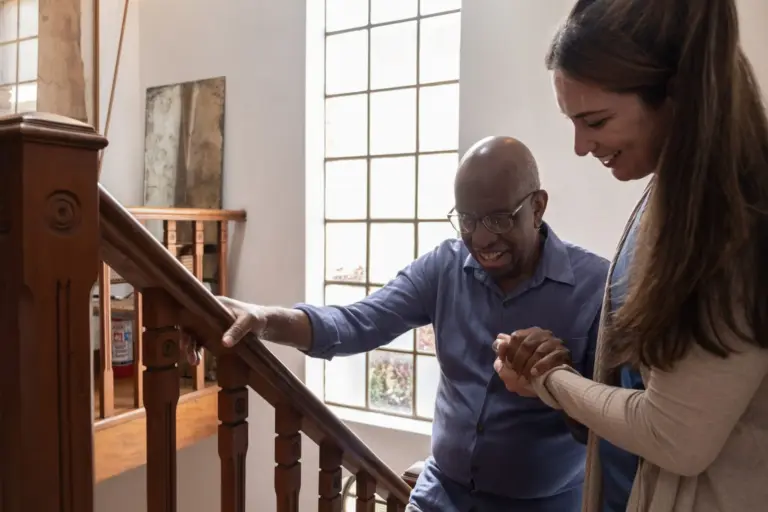
Non-medical support delivered in the person’s own home. A caregiver helps with personal care, meals, housekeeping, transportation, and companionship, on a schedule that ranges from a few hours a week to live-in, around-the-clock coverage.
This is what SYNERGY HomeCare of Mendon provides. It is the option most people say they want, and for many families it is the one that keeps a move off the table entirely.
Assisted Living
A residential community where a person has their own apartment and staff are available to help with daily tasks. Meals and activities are communal. It suits people who need help and also want social contact, and who are willing to leave their home to get it.
Memory Care
Specialized residential support for people living with dementia, in a secure setting built for it. Memory support can also be delivered at home, and our memory care service exists for families who want to keep a loved one in familiar surroundings for as long as it is safe.
Skilled Nursing
Round-the-clock medical care from licensed clinical staff. This is a hospital-adjacent level of care, for people with medical needs that cannot be met any other way.
Most families do not move cleanly from one of these to the next. It is more common to start with a few hours of in-home help and increase from there.
What Long-Term Care Is Not
It is not the same as home health care Home health is medical: skilled nursing, wound care, physical therapy, delivered by licensed clinicians and frequently covered by Medicare after a qualifying hospital stay. It is usually short-term and tied to a specific recovery.
It is not medical care SYNERGY HomeCare of Mendon is non-medical. We do not provide nursing, therapy, wound care, or medication administration. We provide the daily support around those things, and we work alongside any clinical providers already involved.
It is not automatically permanent Some people need long-term care for years. Others need it for a season, after a stroke or a fall, and step it back down. Care should be able to move in both directions.
How Long-Term Care Works at Home in Mendon
For families across Mendon and the Blackstone Valley, long-term care most often looks like this: a caregiver comes in, on a schedule built around the actual gaps, and does the things that have become difficult.
Personal care Bathing, dressing, grooming, toileting, and safe transfers, handled with patience and privacy.
Meals and household support Cooking, laundry, light housekeeping, and the errands that quietly stop happening when someone is struggling.
Transportation Rides to appointments, the pharmacy, the store, and anywhere else that keeps a person part of their own life.
Companionship Isolation does real damage. Our care and companionship service treats that as care, not as a nice extra.
Overnight and 24-hour coverage Available where the need runs through the night, up to and including live-in support.
Respite for the family If a spouse or an adult child is currently the long-term care plan, that is not sustainable indefinitely. Our respite care resources exist for exactly that.
Our full range of home care services sets out what a plan can include.
How Do You Know When It Is Time?
There is rarely a single moment. There is usually a slow accumulation that a family only recognizes in hindsight. These are the signals worth taking seriously.
The house has changed Mail piling up, food spoiling in the refrigerator, laundry not getting done, the place no longer kept the way they always kept it.
Personal care is slipping Wearing the same clothes for days, skipping showers, losing weight without explanation.
Something happened A fall, a near-miss on the stairs, a pan left on the stove, a missed dose that mattered.
They have stopped going out Driving less, then not at all. Declining invitations. Getting smaller.
You are exhausted If you are the plan, and you are running on empty, that is a signal in its own right. It is not selfish to say so.
None of these mean a move. Most of them mean it is time to have a conversation about support at home.
How Much Does Long-Term Care Cost, and Who Pays?
This is where most families get caught out, so here is the honest picture.
Medicare does not pay for it. This surprises almost everyone. Medicare covers short-term skilled home health after a qualifying hospital stay. It does not cover ongoing non-medical help with bathing, dressing, meals, or housekeeping, which is what most long-term care actually is.
Our current hourly rate is $41 on weekdays and $43 on weekends. Beyond that starting number, cost depends on how many hours you need and whether any of them are overnight. A few hours a week is a very different total from live-in support, so we will not guess at a full figure before understanding the situation.
Before you assume it is all out of pocket, check these three.
Long-term care insurance If a policy exists, it frequently covers in-home help with daily living. Many families forget they hold one, or do not realize home care qualifies. Our guide to understanding long-term care insurance explains how to activate a policy, and we can supply the documentation of hours and services these policies require.
Medicare Advantage The one most people miss. Standard Medicare does not cover non-medical home care, but some Medicare Advantage plans do, usually listed as “in-home support.” Benefits vary by plan. See understanding Medicare Advantage.
VA benefits Eligible veterans and, in some cases, surviving spouses may access the Aid and Attendance pension benefit or the VA Homemaker and Home Health Aide program. Our office has real, hands-on experience with veteran home care and will help with the paperwork.
Our paying for care page goes through the options in full. The Mendon Council on Aging and Senior Center on Providence Street can also connect residents and caregivers to local programs.
Frequently Asked Questions
Does Medicare cover long-term care?❯
No, not the ongoing non-medical kind. Medicare covers short-term skilled home health, meaning nursing or therapy, usually after a hospital stay. It does not cover help with bathing, dressing, meals, or housekeeping on an ongoing basis. Long-term care insurance, some Medicare Advantage plans, and VA benefits are the routes worth checking.
Is long-term care the same as a nursing home?❯
No. A nursing home is one end of the range. Long-term care includes in-home support, assisted living, memory care, and skilled nursing. Most families start at the in-home end, and many never need to move beyond it.
How long does long-term care usually last?❯
It varies enormously. Some people need it for a few months after a fall or a stroke. Others need it for years. Care can be increased or reduced as needs change, and there is no long-term contract.
Can we start small?❯
Yes, and most families should. A few hours a week is a legitimate plan, not a token gesture. It is far easier to build from there than to start from crisis.
Is any of this medical care?❯
No. SYNERGY HomeCare of Mendon is non-medical. We do not provide nursing, therapy, wound care, or medication administration. We work alongside any medical providers involved, and we do not replace them.
How do we get started?❯
Call (508) 388-4600. We will talk through what is actually happening at home and what support would genuinely help. There is no cost and no obligation for that conversation.
Talk It Through With Someone Who Knows Mendon
You do not need to have decided anything before you call. Most families reach out precisely because they do not know what they are looking at yet, and working that out is the job.
SYNERGY HomeCare of Mendon serves families across the Blackstone Valley region of Worcester County, including Mendon, Sutton, Uxbridge, Hopedale, Millville, Douglas, Northbridge, and Blackstone.
Call us at (508) 388-4600 or schedule your free consultation. We will listen first, be straight with you about what we can and cannot do, and help you understand the options even if you do not choose us.